- Home
- Playground turf
Playground turf
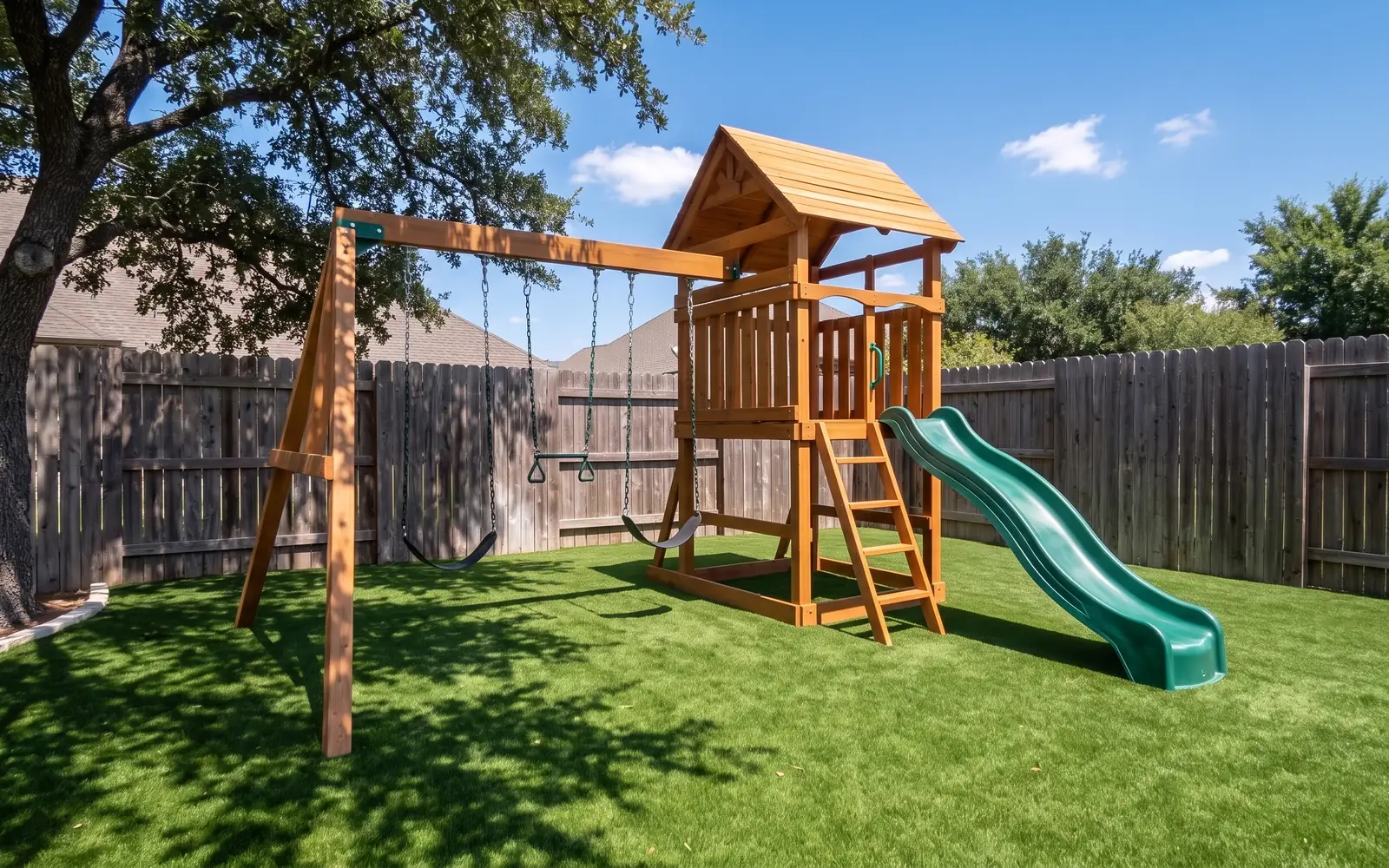
The highest platform on your play equipment sets the fall height the surface underneath has to soften. Around Austin and Central Texas, we install turf over a shock-absorbing pad, and the system should carry ASTM F1292 test data for its critical height rating.
Per square foot, installed (Fixr's 2022 figure, pad not specified)
Fixr, 2022
Why playground prices are thin, and what a shock pad and a critical height rating mean.
Playground costsTurf under play equipment
The U.S. Consumer Product Safety Commission’s playground handbook lists grass and dirt as inappropriate surfacing under equipment. The handbook says wear and weather reduce their shock-absorbing effectiveness.
In 2025, City of Austin Watershed Protection staff listed playground turf layers from top to bottom as turf blades and infill, a shock-absorbing pad, a leveling layer, base gravel or rock, and compacted native soil. Infill is sand or granules brushed down between the turf blades. The pad does the cushioning, and HomeGuide describes a shock pad as a cushioned underlayment that adds padding for play areas and reduces impact injuries. City of Austin Watershed Protection says crumb rubber infill is still used in playgrounds for its shock-absorbing qualities.
Shock pads and critical height ratings
ASTM F1292’s 2026 edition is the lab standard for measuring how well a playground surface absorbs impact. It expresses the result as a critical height and uses two impact scores, g-max and Head Injury Criterion (HIC), to assess the risk of head injury.
CPSC’s Public Playground Safety Handbook says the critical height rating should be greater than or equal to the fall height of the highest piece of equipment on the playground. The Consumer Product Safety Commission also says to request ASTM F1292 test data from the manufacturer that identifies the critical height rating. For turf, ask for test data on the turf-and-pad system showing a critical height at or above your equipment’s fall height.
What playground turf costs
Fixr’s 2022 cost guide puts installed playground turf at $6 to $20 per square foot, though it doesn’t say whether a pad is included. No newer major cost guide prices playground turf, so keep that date in mind when comparing playground costs.
What to have ready
Tell us the height of the play set’s highest platform or swing beam so we know the fall height the surface has to match. We’ll also need the play set’s footprint, the open space around it, and what’s under it now, whether that’s grass, dirt, mulch, or concrete. If you’ve picked a pad or surfacing product already, have its ASTM F1292 test data ready. CPSC says that data identifies the critical height rating, the fall height the surface is rated for.
Sources
- ASTM International, "F1292 Standard Specification for Impact Attenuation of Surfacing Materials Within the Use Zone of Playground Equipment as Tested in a Laboratory," September 14, 2026.
- U.S. Consumer Product Safety Commission, "Public Playground Safety Handbook," November 2010.
- City of Austin Watershed Protection, "Artificial Turf: Water Quality Considerations," November 5, 2025.
- HomeGuide, "How Much Does Artificial Grass Cost? (2026)," October 21, 2025.
- Fixr, "How much does it cost to install artificial grass?," August 19, 2022.
FAQ
Playground turf questions
Is turf safe under a swing set?
It depends on the system’s test data. CPSC says a surface’s critical height rating should be at or above the fall height of the highest equipment, so turf over a pad qualifies only if its ASTM F1292 test data shows that. CPSC considers carpeting and mats inappropriate unless they’re tested to and comply with ASTM F1292.
What is a critical height rating?
A critical height rating is the result of a lab test under ASTM F1292. The test measures impact using g-max (an impact score) and Head Injury Criterion (HIC) scores to assess head injury risk, then expresses the result as a critical height. CPSC says that rating should be greater than or equal to the fall height of the highest piece of equipment.
Does playground turf need a shock pad?
Yes, plan on a shock pad under play equipment. HomeGuide describes a shock pad as a cushioned underlayment that reduces impact injuries in play areas. The critical height rating comes from testing the turf and pad together, so ask for the system’s ASTM F1292 data.
Can playground turf go over concrete?
Playground turf can go over concrete only as a system made and tested for it. CPSC says concrete, asphalt, or other hard surfaces should never be directly under playground equipment. CPSC tells buyers of unitary surfaces, its term for rubber mats and tiles or materials bound or poured into one shock-absorbing surface, to get the manufacturer’s site requirements because some can go over a hard surface and some can’t. A turf-and-pad system over concrete needs the manufacturer’s site requirements and F1292 test data for that build.