Where turf does well
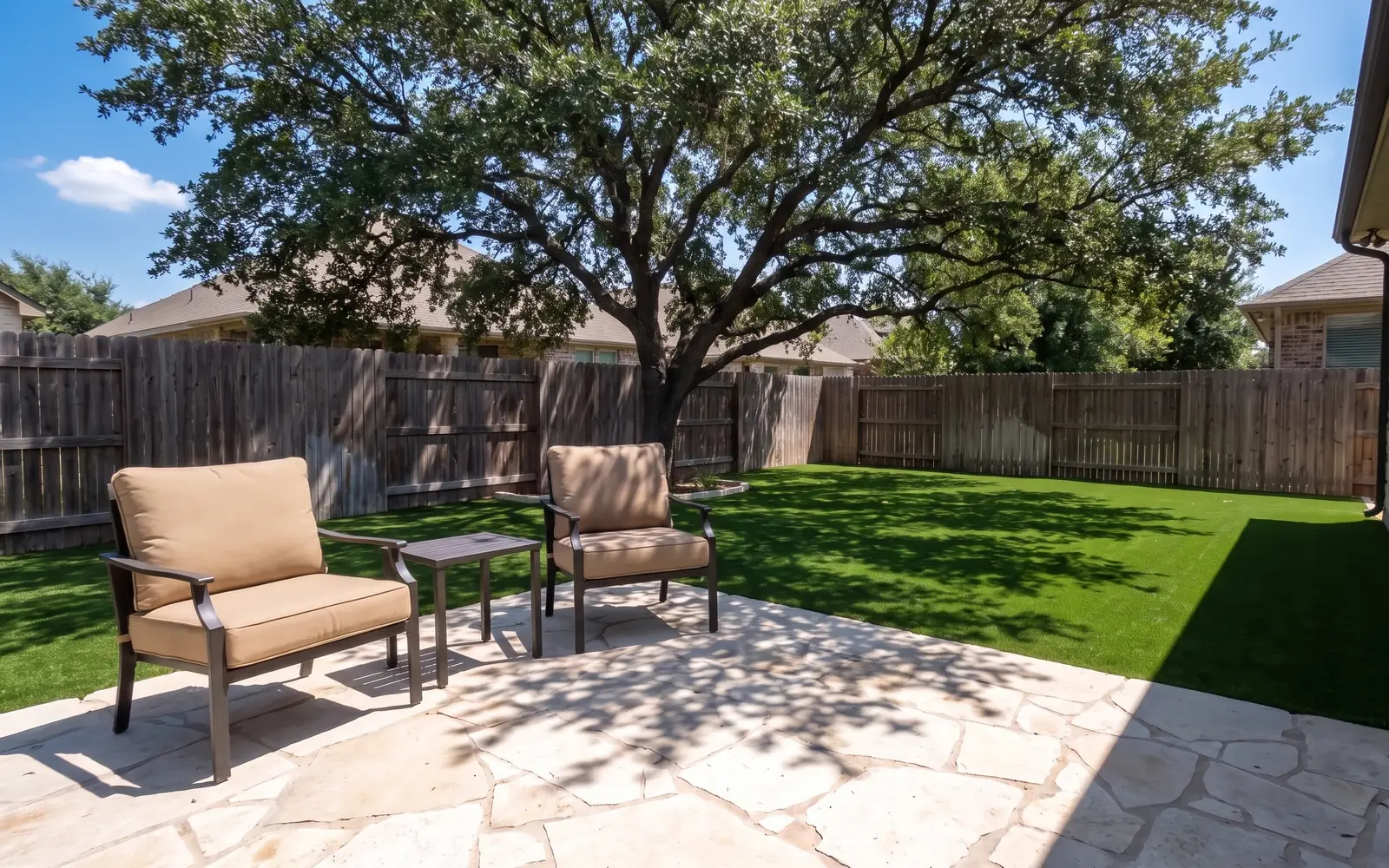
Turf needs no mowing or watering to stay alive. HomeGuide’s 2025 guide says it works where natural grass struggles to grow, such as shaded yards and high-traffic zones. Angi’s 2026 guide puts its lifespan at 10 to 20 years with very little maintenance. LawnStarter’s 2026 guide puts yearly upkeep at about $250 to $350 for brushing, minimal watering, and occasional infill, which is sand or granules brushed down between the turf blades.
Turf suits small areas that get hard use, and Angi’s 2026 guide puts its life with dogs at about 10 to 15 years when it has a quick-draining backing and odor-control infill. HomeGuide’s 2024 guide says turf built for golf greens needs minimal maintenance. In play areas, turf goes over a shock pad, and ASTM F1292 test data show the surface’s critical height rating, the fall height it’s rated for. Turf backings let water through, and spec sheets that rate drainage in inches per hour use the ASTM F1551 test.
Where turf falls short
HomeGuide’s 2025 cost guide puts installed turf at $10 to $25 per square foot and new sod at $1 to $2 per square foot, so turf costs more up front. In the sun, turf can get much hotter than grass. City of Austin Watershed Protection staff said in November 2025 that turf gets none of the cooling grass gets from water evaporating off its leaves and can be as hot as or hotter than concrete.
Turf wears out, and HomeGuide’s 2025 cost guide puts replacement at $10 to $25 per square foot, about the same as a new installation. Angi’s 2026 pet turf guide says crumb rubber and sand infill, the granules brushed between the blades, hold urine odors, and LawnStarter’s 2026 guide says pet areas need a cleaning solution from time to time. In Austin, Austin Water’s rebate excludes artificial turf, and Texas HOA law doesn’t specifically protect it, as the cost guide’s rebates and rules section explains.
How hot artificial turf gets
Most published heat measurements come from athletic fields with crumb-rubber infill. Brigham Young University found in 2002 that synthetic turf on an athletic field averaged 117°F over the day, compared with 78°F for natural grass, and reached a high of 200°F on a 98°F day. Penn State’s Center for Sports Surface Research found in 2012 that every synthetic turf system it tested passed 150°F. BYU’s safety office set 120°F as the field’s maximum, and BYU noted that at 122°F, skin injury takes less than 10 minutes.
Two reports looked at home and city landscapes. UC Cooperative Extension’s Janet Hartin measured synthetic lawns up to 173°F in Palm Springs, California, in 2024, while plants measured 90°F to 100°F. UF/IFAS’s Marco Schiavon found turf up to 174°F and natural turf about 102°F in California urban landscapes in 2025. Penn State’s sports surface researchers found that watering cools synthetic turf for about 40 minutes.
| Study | Surface measured | Turf | Comparison |
|---|---|---|---|
| Brigham Young University (Williams and Pulley), 2002 | Athletic field | 117°F average, 200°F peak | Natural grass 78°F average |
| UNLV and Desert Research Institute, 2008 | City park and test plot | Up to 169°F | About 69°F above irrigated grass |
| Penn State Center for Sports Surface Research, 2012 | Athletic field systems | Above 150°F in every system tested | Air temperature 88°F to 99°F that day |
| UC Cooperative Extension (Hartin), 2024 | Home synthetic lawns | Up to 173°F | Plants 90°F to 100°F |
| UF/IFAS (Schiavon), 2025 | Urban landscapes | Up to 174°F | Natural turf about 102°F |
How long artificial turf lasts
HomeGuide’s 2025 guide gives properly maintained turf 15 to 25 years. Angi’s 2026 guide says 10 to 20 years, though turf in high-traffic areas, near pools, or used for fitness may last only 3 to 5 years. HomeAdvisor’s 2026 guide puts turf at 5 to 10 years, or about 3 years in high-traffic areas. Angi and HomeAdvisor are the same company, yet their published lifespans disagree.
Angi’s 2026 pet turf guide puts turf used by dogs at about 10 to 15 years. HomeGuide’s 2024 guide says properly maintained backyard putting greens last 10 to 15+ years. How hard the turf gets used decides where it lands in those ranges.
Is it worth it?
We think turf is worth it for small, hard-used areas like a dog run, a putting green, or the ground under play equipment over a shock pad. For a large, sunny lawn, we usually don’t think it’s worth it. HomeGuide’s 2025 figures put sod at $1 to $2 per square foot and turf at $10 to $25 per square foot, and grass stays far cooler in the sun.
The turf vs. sod choice flips toward turf if you can’t or won’t water and mow. It flips away from turf where kids or dogs use the area on summer afternoons in full sun because of surface heat.
Sources
- HomeGuide, "How Much Does Artificial Grass Cost? (2026)," October 21, 2025.
- Angi, "How Much Does Artificial Grass Cost to Install? [2026 Data]," September 5, 2026.
- LawnStarter, "How Much Does Artificial Grass Cost in 2026?," October 5, 2026.
- Angi, "Pros and Cons of Artificial Grass With Dogs," July 9, 2026.
- HomeGuide, "How Much Does a Backyard Putting Green Cost? (2026)," January 31, 2024.
- ASTM International, "F1292 Standard Specification for Impact Attenuation of Surfacing Materials Within the Use Zone of Playground Equipment as Tested in a Laboratory," September 14, 2026.
- U.S. Consumer Product Safety Commission, "Public Playground Safety Handbook," November 2010.
- Lee Building Products, "LEEBP-78," March 11, 2026.
- Turf & Ivy, "HARMONY," October 20, 2024.
- Turf & Ivy, "STABILITY," October 20, 2024.
- HomeGuide, "How Much Does Sod Installation Cost? (2026)," October 31, 2025.
- City of Austin Watershed Protection, "Artificial Turf: Water Quality Considerations," November 5, 2025.
- HomeGuide, "How Much Does Sod and Grass Removal Cost? (2026)," October 31, 2025.
- Austin Water, "WaterWise Landscaping Rebate Guide," undated, read October 8, 2026.
- Texas Constitution and Statutes, "Property Code ch. 202," October 8, 2026.
- Brigham Young University (Williams and Pulley), "Synthetic Surface Heat Studies," 2002.
- Penn State Center for Sports Surface Research, "Synthetic Turf Heat Evaluation – Progress Report, January 2012," January 2012.
- UC Cooperative Extension (Janet Hartin), UC ANR Fresno Gardening Green blog, "Fake grass makes hot environments hotter," June 27, 2024.
- UF/IFAS Fort Lauderdale REC (Marco Schiavon), "Scorching temps from California turf raises questions about artificial turf, xeriscaping in humid states like Florida," July 30, 2025.
- Penn State Center for Sports Surface Research (Tom Serensits), "From the Field: Synthetic Turf and Human Health," February 12, 2020.
- HomeAdvisor, "How Much Does Artificial Grass Cost in 2026?," June 20, 2026.
- UNLV and Desert Research Institute, "Study finds artificial turf may be too hot for summer use," September 18, 2008.